Guest Writer: Alex Rusek
Founded in 1835, the City of Lansing has seen great change from its rural roots of the time. Here are 10 facts about Downtown Lansing’s history and architecture that you probably did not know:
1. The Grand River was known to Indigenous peoples as “O-Wash-Ta-Nong,” often translated as “far away water” or “far-flowing water,” the river runs through the middle of Downtown Lansing.
2. Downtown Lansing has a National Register historic district, the Lansing Downtown Historic District was listed in 2009 for its architecture, commerce, and social history. You can experience many types of architecture in Downtown Lansing, such as 19th-century neoclassicism, classical revival, early-20th-century government architecture, Art Deco-era skyscraper design, and contemporary styles.
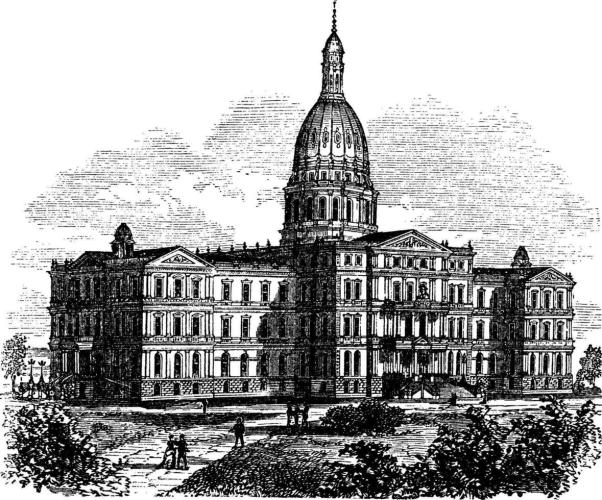
3. The Capitol was designed by Elijah E. Myers and completed in 1879, a major 19th-century architect who designed several state capitol buildings. Myers also designed the capitol buildings in Texas and Colorado.
4. Arbaugh’s Department Store Building was built in 1905 and was the tallest building in Lansing at the time, located at 401 S. Washington Square, the department store became one of Lansing’s major early retail landmarks. Today, the building holds commercial and residential spaces.
5. The former Masonic Temple at 217 S. Capitol Avenue was completed in 1924 and is an example of the classical revival style. In 1974, Cooley Law School acquired the building and continued to use it as a law school until 2008.
6. Boji Tower was completed in 1931; the 22-story building is registered on the National Register of Historic Places as the Capital Bank Tower, but it was originally known as the Olds Tower.
7. Knapp’s Centre opened in 1937, a major department store, and remains one of downtown’s standout Art Deco-style buildings, now featuring commercial and residential space.
8. The Ottawa Street Power Station was built in 1939 on the banks of the Grand River; the facility’s electric and steam generation ended in 1992, and the facility was later repurposed as office space for the Accident Fund Insurance Company and remains in use today.
9. The R.E. Olds Museum was opened to the public on May 18, 1981, and currently houses an extensive collection of automobiles, engines, and other automotive materials significant to the transportation history of the region. The James D. Butt Archives contain hundreds of thousands of pieces of ephemera such as photographs, drawings, manuals, newsletters, and other records.
10. The George W. Romney Building serves as the official office of Michigan’s Governor. Originally built as a hotel in the 1920s, it was acquired by the State of Michigan in 1988 and thoroughly renovated.